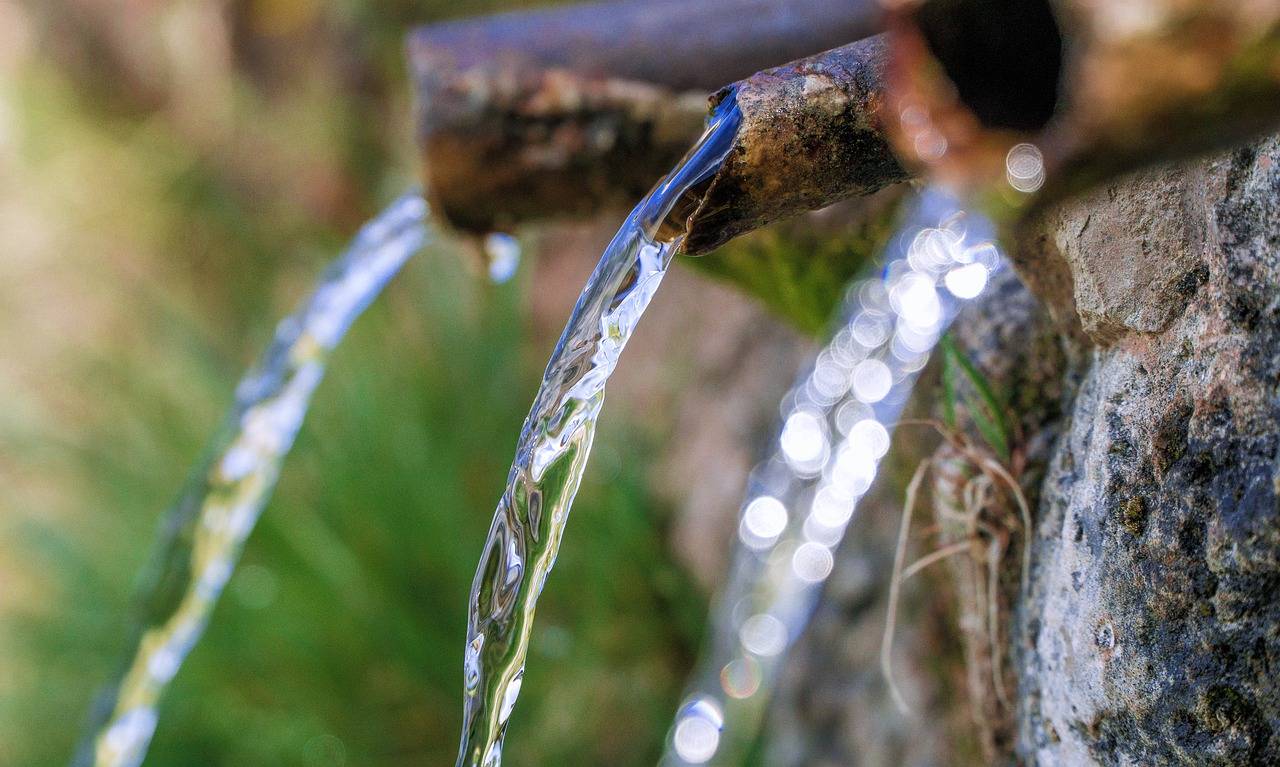
The Holy Land was an enticing, blessed land for the nomadic people living in the arid deserts in the south and east of the country. In the 5th book of Moses (= Deuteronomy) the following description can be found:
The LORD thy God shall bring thee into a land of glory, a land of brooks, fountains, and waters that spring up in the valley and on the mountain, a land of wheat and barley, of vine, fig tree, and pomegranate, a land of olive tree and honey, a land where thou shalt not eat thy bread poorly, where thou shalt not want for nothing, a land where thy cattle, and thy sheep, and thy goats, shall multiply.
The land became the Promised Land primarily because of the presence of water. Rainfall in the Holy Land was usually sufficient, but not evenly distributed throughout the year and the various regions. It falls exclusively in the winter months and is completely absent in the hot summer months. Then the streams in the mountainous areas dry up, and plants that do not have deep roots wither. Time and again, there were years in the Holy Land when there was too little rain or none at all. The result was drought and famine. The Bible tells of this in the story of Joseph, in the Book of Ruth and especially impressively from the time when King Ahab and the prophet Elijah were hostile to each other.
In order to have water available all year round, people already in biblical times captured the available springs. These provided the purest water. But since there were not enough springs, the inhabitants dug wells where possible to get groundwater. And they channeled the rainwater into basins and cisterns, which they had chiseled into the rocky subsoil in many places.
People met at the springs and wells when they came to draw water from them, which they then carried home to wash or drink. Jesus had an intense conversation with a woman from Samaria at Jacob's well.
At some watering places there were drinking troughs for the herd animals. Things were not always peaceful there. The first book of Moses tells of disputes at wells and cisterns, but also of Rebekah's fateful encounter with Abraham's suitor and the romantic meeting of Jacob and Rachel while watering the animals.
Drained well shafts and cisterns were occasionally misused as dungeons. Joseph and the prophet Jeremiah found themselves in them unawares.
Clay jugs were used to store water in the houses. They were not glazed, therefore not completely waterproof, rather they permanently sweated out water. Heat extraction during evaporation led to a natural and very desirable cooling of the water inside the jugs.
High stakes
Monotheism, the belief in one God, the creator of heaven and earth and since responsible for all areas of life, distinguished the children of Israel from the peoples surrounding them. The latter usually had several deities with specific areas of responsibility
Monotheism, the belief in one God, the creator of heaven and earth and since responsible for all areas of life, distinguished the children of Israel from the peoples surrounding them. The latter usually had several deities with specific areas of responsibility
In the 1st Book of Kings it is reported that King Ahab took as his wife Jezebel, a princess from the neighboring royal house of Sidon, who was an ardent worshipper of the god Baal and Asherah. She persuaded her husband to pay homage to these deities, as well, and to erect a sacrificial sanctuary and a statue to them.
This called the prophet Elijah on the scene, who resolutely stood up for the belief in one God. As proof of the powerlessness and nullity of the weather god Baal, he announced a great prolonged drought. Baal was considered by his followers to be the cause of dew, rain, thunderstorms, hail and snow, who threw himself into the fray during the months of heavy precipitation and then - during the summer months - took a well-deserved rest. If new rainfall was urgently needed, his followers tried to wake him up again by singing and stamping and to strengthen him for new rain-giving activities by providing offerings.
The announced drought came, with it a great need in the country. All attempts by Baal's followers to bring him into action were unsuccessful. Elijah was declared public enemy No. 1 and hid first at a small stream in the Jordan Valley, then abroad. When the situation in the country finally became completely desperate, Elijah returned and challenged Ahab and the priests of Baal to a final contest. Two altars were to be built on Mount Carmel, one for Baal, one for the One and Only God. Whichever deity would succeed in igniting the offering on the altar without human intervention would have proven its superiority or uniqueness
Elijah gave way to the priests of Baal. They completely spent themselves in trying to activate Baal. Then, when Elijah called upon God, fire fell from heaven, completely incinerating the burnt offering on the altar. This was the proof of the nullity of Baal and the power of the One God. And the people paid homage to their God.
Here, the story could have ended, but it did not. Elijah, in a supposed holy rage, had the priests of Baal seized and killed. Then he hurried alongside Ahab's carriage in the pouring rain to the city of Jezreel, where they met Queen Jezebel. She did not concede defeat as expected, but immediately threatened Elijah with the death penalty. The hitherto undaunted Elijah panicked and ran for his life, ever southward, to Beersheba on the edge of the Negev Desert. Totally exhausted, he sank under a broom bush. Totally exhausted and full of self-reproach, he wanted only one thing: to fall asleep, preferably forever.
When he woke up again, God strengthened him through an angel who nursed him back to health. Fully recovered, Elijah received the order to go into the desert of Sinai to the mountain of God, the Horeb. There he settled down in a cave. A voice asked him to step out into the open. There, he had an apparition of God. A hurricane-like storm arose. Elijah retreated into the cave. He felt: God is not in the storm. After that, an earthquake, but Elijah felt: God is not in the earthquake. After that came a great fire. But Elijah felt: God is not in the fire. After that, he heard a gentle whisper. He knew: God is in that whisper. He is not martial but gentle.