Hermann Hesse writes:
„Trees are sanctuaries. Whoever knows how to talk to them, whoever knows how to listen to them, learns the truth. They do not preach, they do not give teachings and recipes, they tell of the primordial laws of life“.
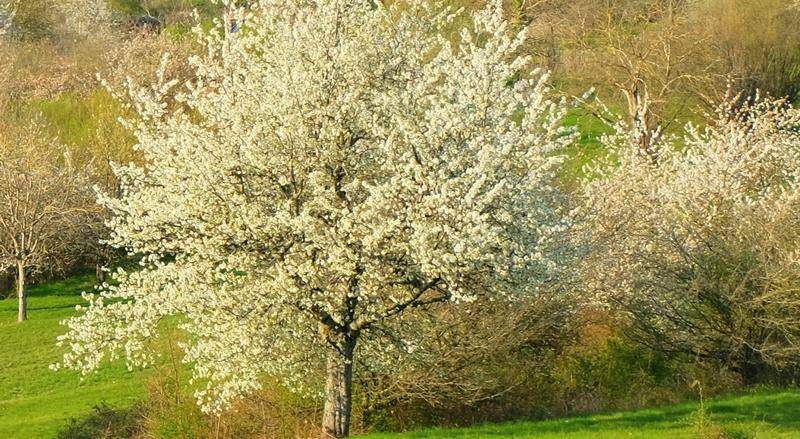
Trees are a good image for rhythm. The entire life in its different phases can be compared with the life of a tree in the seasons. In spring, the first shoots grow slowly until an exuberant force makes the tree turn green explosively fast. In summer, the tree stands with all its vitality - a provider of shade and a safe nesting place for birds. In autumn, the leaves bid farewell with a blaze of color before winter brings a time of rest. We humans also go through such phases in order to grow and develop. This requires a balance between being active and resting, between outside and inside, between giving and receiving.
Consider winter, the time of rest. The forces do not flow outward, we are focused on ourselves. Sometimes, external circumstances impose such a period of rest on us, for example, an illness. They are part of life, these winter times.
Then, the time of blossoms follows once again, the forces develop, we develop new abilities - a promising beginning.
Summer comes, the time in which we are "well in the foliage". Conscious of our strength and power, we pass it on. We can give space and support to other people in such "summery" phases of life.
The time of harvest is the passing on of our fruits, the experiences.
The tree, which lives in the seasons and has its own rhythm, is a good example and also an impetus not to lose sight of the changing times in our own lives.
Fruit Trees in the Bible Garden
Grapevine, olive, pomegranate, date palm, walnut tree, apple tree, mulberry tree, fig and almond tree have defined the cultural landscape of Palestine since ancient times. They grow in the different habitats that the land of Palestine offers: the mountainous country and the desert, the fertile Nile Valley and the Jordan Rift Valley.
Grapevine, olive, pomegranate, date palm, walnut tree, apple tree, mulberry tree, fig and almond tree have defined the cultural landscape of Palestine since ancient times. They grow in the different habitats that the land of Palestine offers: the mountainous country and the desert, the fertile Nile Valley and the Jordan Rift Valley.
Already in the creation account, it is told that God gave the fruits of the trees to man. The fruit trees symbolize the image of the paradisiacal state. They were so precious that it was forbidden to cut them down. An orchard was an important source of life.
When Israel lived in Egypt and was forced into slave labor, God promised to lead the people to a good land. There, "seven kinds" of fruit were to grow: Grapevines, fig trees, pomegranates, olive trees, date palms, wheat and barley. Five of these plants are fruit trees.
Securing the basis of life characterizes the everyday life of people in biblical times. The fruit trees provide food, but also building material. All parts of the fruit trees are used: The fruits are eaten, wood, bark and leaves serve as building material, raw material for handicraft work, dyes and fuel.
Fruits are vital as food, have healing properties and often have a symbolic meaning. They indicate fertility, justice, beauty and love, well-being and peace or other dimensions of life. Thus, a blossoming, green tree stands for a life blessed by God, while a withered tree is the symbol of a person turned away from God.
In the following, we will show you some special trees in our garden.